Capstone project | Multimedia deliverable

Bridging the Operational Divide

Internal communication and safety escalation for frontline youth development staff. Three short videos, a print ready shift kit and a communication playbook, built for Extend-A-Care for Kids at Kyle Elementary.

3 videos, silent, every word on screen 5 min 10 sec of viewing Shift kit, print ready
The series

Three videos, one shift

Each runs about two minutes. No audio, and every word is on screen, so they work on a phone with the sound off, in a hallway, or on a break room screen.

The Daily Mission & Mindset

1:31

Connects a shift to the mission families actually feel, then gives three anchors any staff member can use the same day.

Download MP4, 6.6 MB

Safety & Emergency Escalation

2:04

The escalation order, the twelve second report, and the three things not to do when a child is in trouble.

Download MP4, 9.5 MB

Closing the Loop

1:34

What happens after a staff member reports a problem, and the exact sentence to use when nothing happens.

Download MP4, 7.0 MB

What each video hands you

The videos are not the deliverable on their own. Each one is paired with a card that survives the shift and a page of the playbook that explains the rest.

VideoThe move it teachesThe toolPlaybook
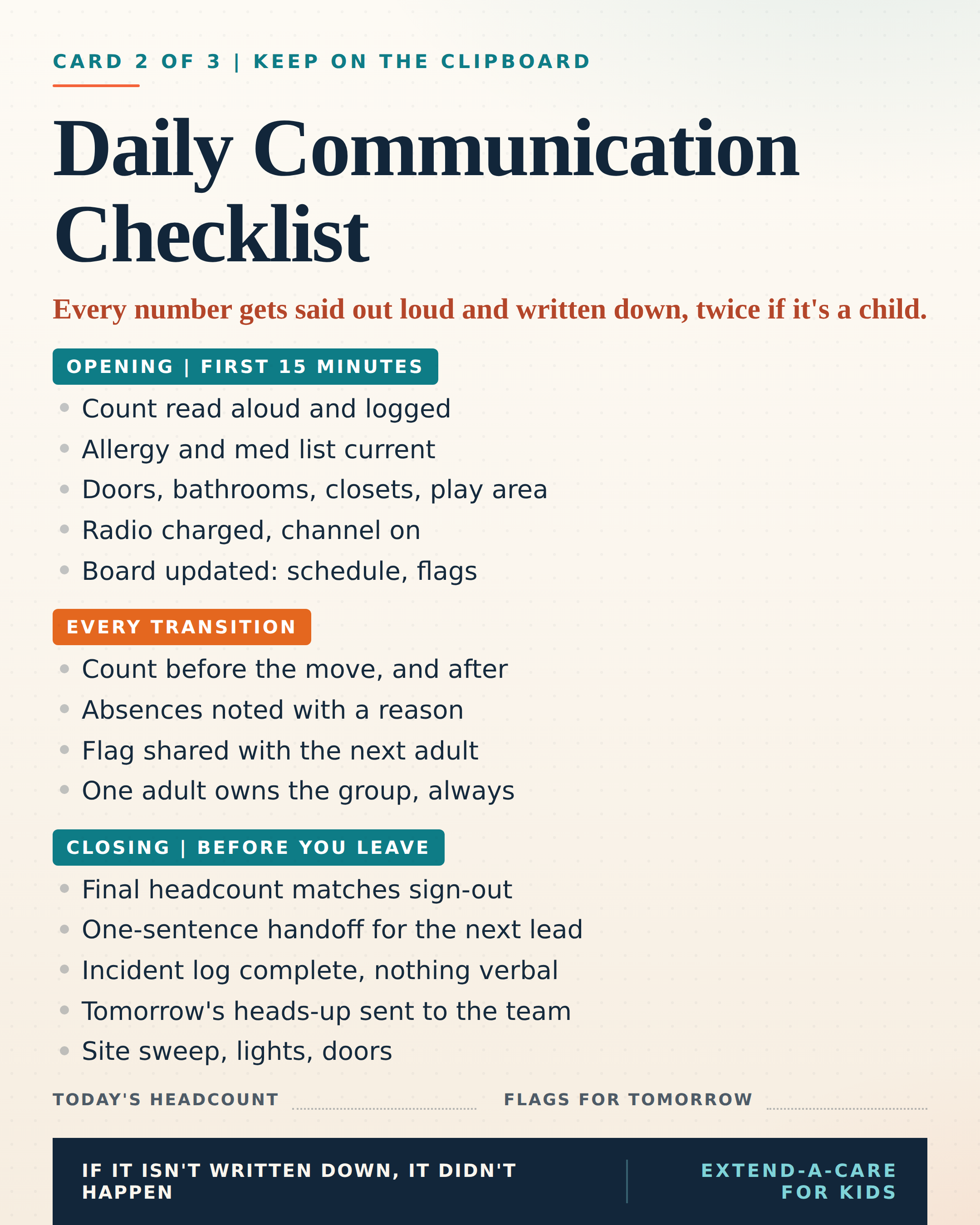
Part 1The Daily Mission & MindsetTurn a shift into a mission a family can feelCard 2, the daily checklistThe rhythm that holds it together
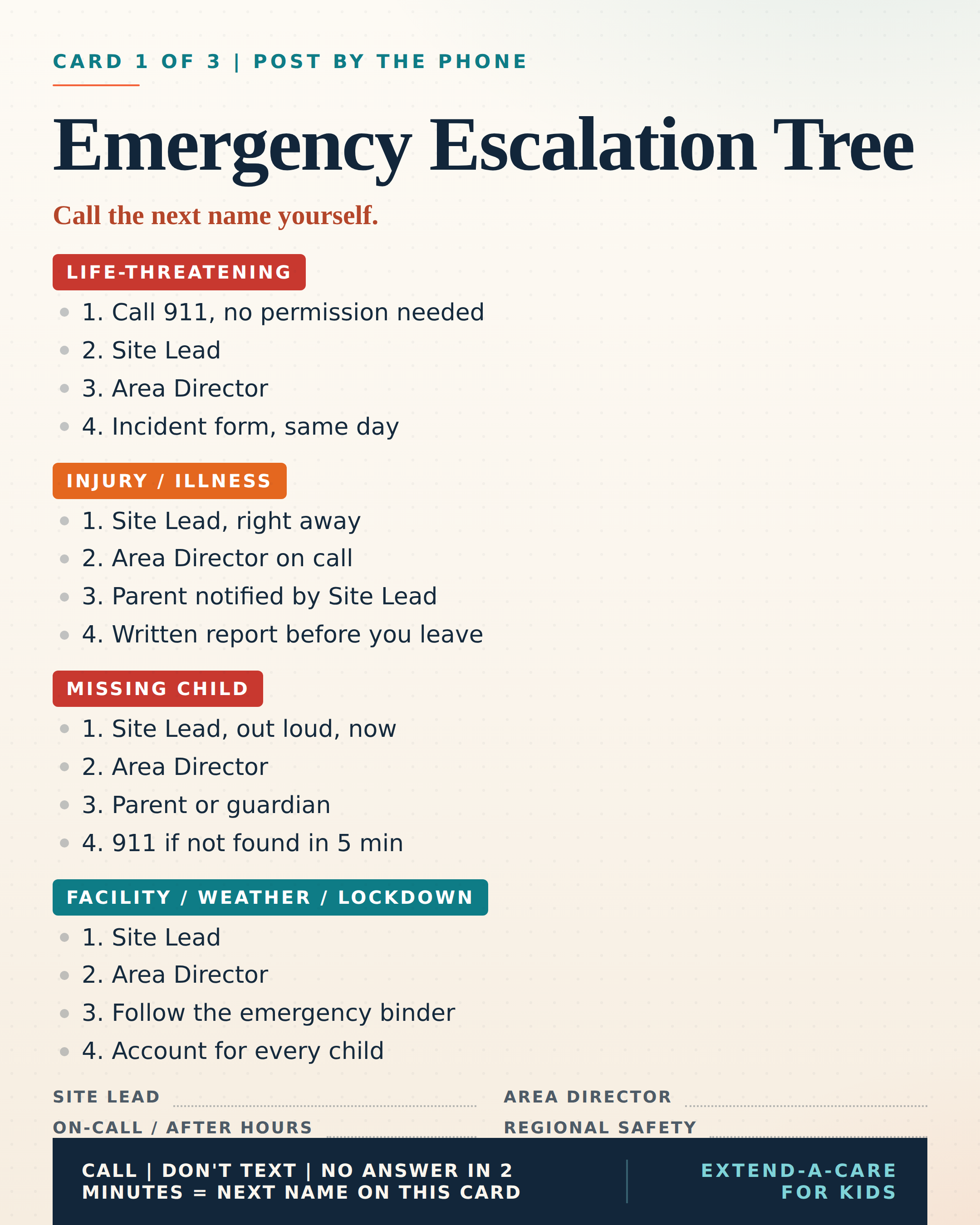
Part 2Safety & Emergency EscalationReach the right person inside two minutesCard 1, the escalation treeMatch the channel to the situation
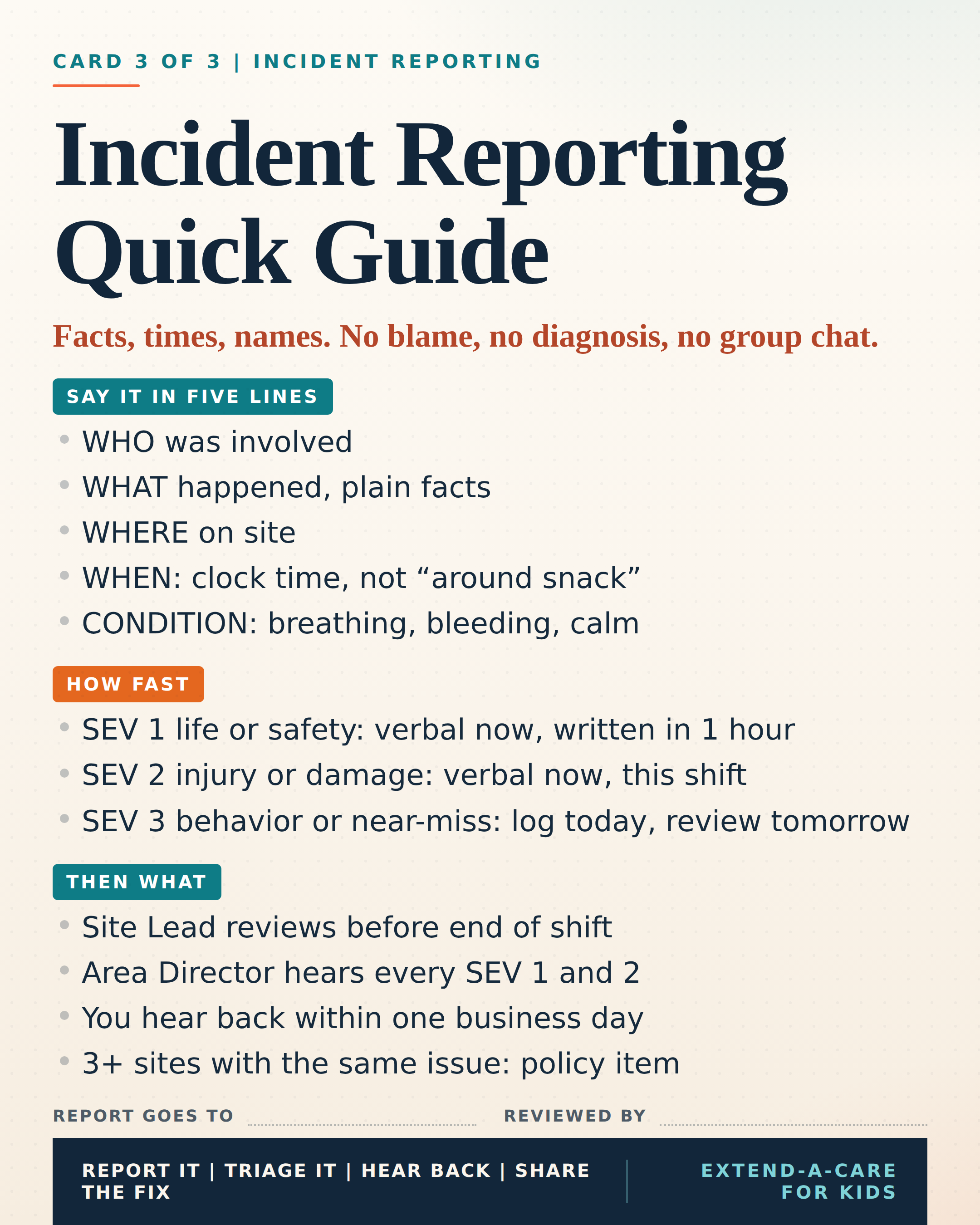
Part 3Closing the LoopAnswer the report, even when the answer is noCard 3, the incident guideThe weekly communication log
Digital shift kit

Three cards for the wall

Tap a card to see it full size. The print file puts one card on each Letter page. Every card and the playbook are also in Spanish: use the Español link at the top.
Download the print file

Angelina Nelson | Bridging the Operational Divide | Communication playbook
Communication playbook

Who hears what, and when

Most communication failures on site are not emergencies. They are ordinary days when nobody is sure who to tell. This is the answer sheet, in the same order you would use it.

Match the channel to the situation

The mistake is not choosing badly. It is choosing slowly, or putting something that needs a phone call into a group chat.

SituationWhat to doWho owns itStandard
Life threateningCall 911 first, then phone your Site LeadStaff member on siteNow. No permission needed.
Injury or illnessPhone the Site Lead, then file the incident formSite LeadVerbal in 2 minutes, written before you leave.
Missing child or wrong pickupSay it out loud, then phone the Site Lead and the Area DirectorSite LeadImmediately. 911 at 5 minutes.
Something blocking your shift todayCall your Site Lead. Do not text itSite LeadAnswered or escalated within 2 minutes.
A note for the next person on shiftShift note, written before you goNext leadIn the log before handoff.
The same problem across sitesArea report, with the dates and the site namesArea DirectorTriaged within 1 business day.

Who needs to hear what

Same information, different audience, different moment. Getting this order wrong is what makes staff feel unheard and families feel surprised.

AudienceWhat they needWhen
Staff starting a shiftThe count, the open flags, who is out todayFirst 15 minutes
Staff ending a shiftWhat changed, what to watch, what is still openLast 15 minutes
Site LeadAnything touching safety, coverage gaps, parent concernsSame day, verbally
Area DirectorEvery SEV 1 and SEV 2, plus repeat issuesWithin 1 business day
Parent or guardianAnything about their child they should hear from us firstBefore pickup
Every familyA rule or schedule change that affects themBefore it takes effect

The twelve second report

WHOWHATWHEREWHENCONDITION

Five lines, in that order, every time. It works spoken on the phone, typed into the incident form, and repeated to a parent.

Amara. Asthma. Playground. Three ten. Inhaler used, breathing tight but talking.
Twelve seconds. Enough for the Site Lead to act instead of guess.

The handoff sentence

[Child] was [state] at [time]. Watch for [flag]. Next step is [action].

One sentence per child who needs one. Not a paragraph, and never a verbal shrug at the door.

Jayden was quiet after snack. Watch for the stomach ache he mentioned. Next step is a call to mom if he skips dinner.

The rhythm that holds it together

Four short moments, every day and every week. Nothing here needs a meeting room.

Opening huddle15 minutes with the whole teamCount read aloud, allergies, who is out, the one thing to watch today.
Mid-shift checkOne minute, lead to staffCounts still match, any flag since the door, anything the next person needs.
Closing handoffBefore the last person leavesCount matches sign-out, incident log complete, one sentence for tomorrow.
Weekly reviewSite Lead, 20 minutesRead the log back, find the repeat, send what belongs to the Area Director.

Weekly communication log

Print this page for the site binder. One line per item raised. The closed column is the one that builds trust, so leave it empty until it is actually closed.

DateWhat was raisedRaised toAcknowledgedClosed

A closed item means someone told the person who raised it what happened, even when the answer was no.

Download this playbook